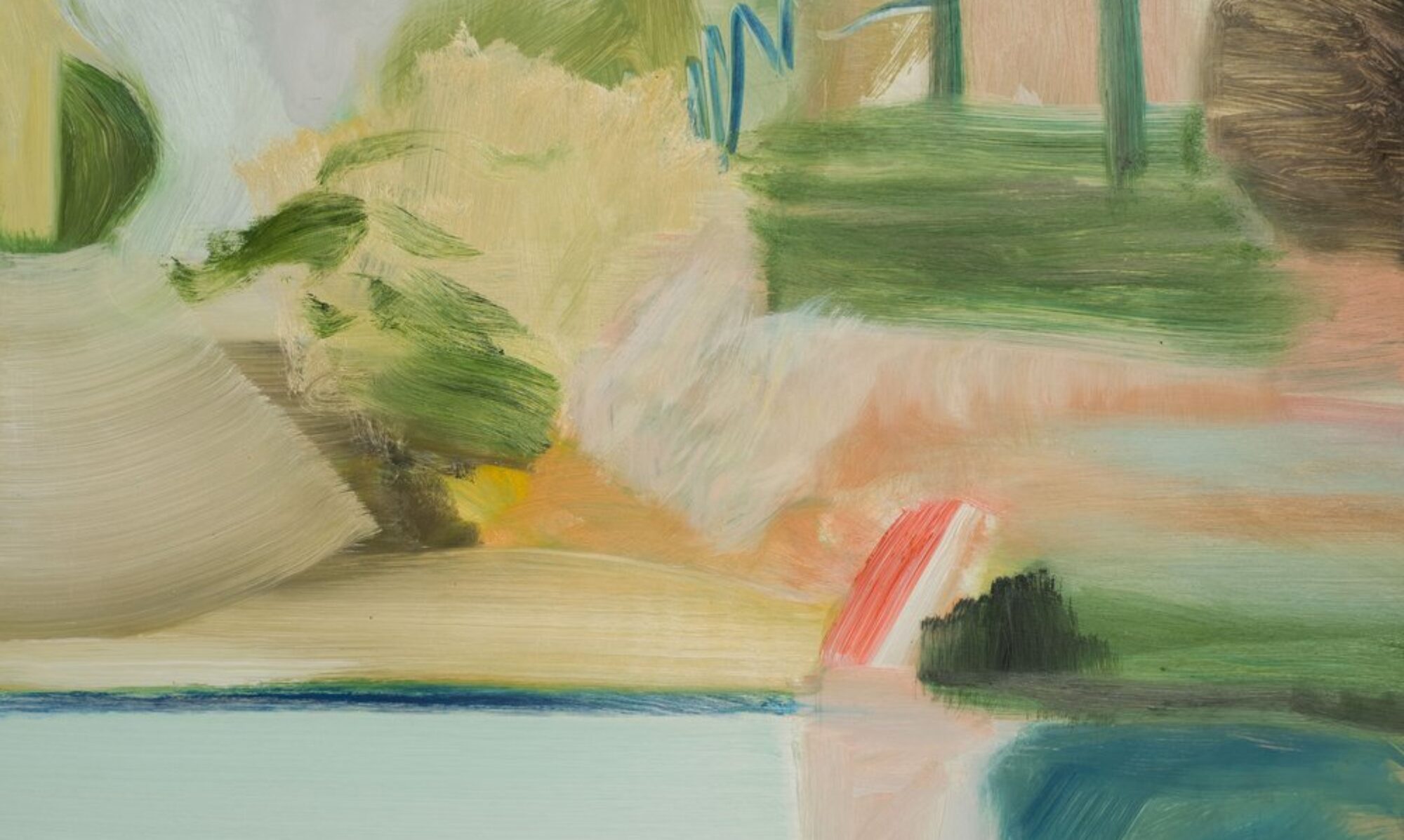

Helen Leaver’s latest group of paintings draw on the artist’s experiences of landscape, meditation and material experimentation. Inspired by the Tea Roses growing next to the painting studio in her garden, Helen’s ‘Romantic Reverie’ series have just returned from exhibition at The Poly in Falmouth.
Pendour’s Linda Bell caught up with the artist to discuss the development of this body of work, the influence of place and the experiences that have shaped Helen’s artistic journey.
This Conversation Piece is perfectly timed to coincide with Helen’s current solo show at The Square Club in Bristol, which also marks a return to the city the artist once called home.

Helen’s solo exhibition opened on 7th May and continues through the Summer at The Square Club, Berkley Square, Clifton.
LB : Great to see you and thanks for doing this today. I think it will be really nice to spend some time thinking about your work, talking about it and for me to learn some more about your paintings. So you just had your show last week?
HL : I did! And it went really well. The Poly is a multi-purpose venue, really. So they have a cinema, they have a theatre, upstairs is the massive workspace and then downstairs you’ve got the shop and then a dedicated gallery space. So as an artist you can hire it for a week or five days. I did that with my friend. And it’s great. You get to plan and curate it yourself and it’s fabulous, it’s a really cool place to exhibit.
LB: I didn’t realize it was such a big set up there. That’s wonderful. I wish I could have been there to check it out, but what about your exhibition at the Square Club? That’s starting very soon?
HL: On Thursday.
LB: Wow!
HL : So yes, so I’ve got about twenty-two paintings.
LB: Ok.
HL : I’m taking a few more just in case and then I’ve got an open evening. The Square is part of the Berkeley Square Hotel, so it’s a members’ club, but it’s also a place where you can get married. So you can hire it to get married –
LB: Wonderful!
HL : It’s beautiful and just really…. It’s got history. It’s a really old Georgian house and they’ve converted it and it’s got beautiful mirrors and windows. And my art will be interspersed with all these really nice architectural features in the building and I’m really privileged because of course they’re going to be there when people get married.
LB : Ohh, wow, amazing.
HL : So they’re going to literally say their vows where my paintings are going to be.
LB: Amazing. What a nice thing to do.
HL : So it’s the whole of May, the whole of June and the whole of July. It will open me up to a new audience outside of Cornwall.
LB : Of course, absolutely.
HL : I used to live in Bristol. I used to work on Berkeley Square before I had the children, so I used to walk past this venue, The Square, I don’t know, four or five, six times a day. And now I’m exhibiting there for three months. How cool is that? Feels like a real ‘full circle’ moment.

LB : Amazing.
HL : So I think my paintings will work really well if they have a wedding there. My work at the moment has been quite floral inspired, specifically my (own) wedding bouquet. So it’s all sort of come together. I didn’t deliberately paint my wedding bouquet with a view that they’re going to be in a wedding venue, it was just luck and …
LB : Happenstance and chance?
HL : Yeah, serendipity. Is that a cool word to use? Something like that? Yeah. So I’m really excited.
LB : Things happen like that! Fantastic. So not just wedding guests and people getting married, but what kind of experience do you hope visitors will have when they encounter your paintings at The Square Club?
HL : Well, having done the exhibitions in Falmouth before, I did one last year as well, you have to invigilate. So you have to sit there, stand there and talk to people. But the great thing is, you get to see how people respond to them (the paintings) in real time and it’s such an eye opener. It’s a privilege as well.
This dog came in, it was a whippet or something and with its owner obviously and just slumped in a big circle right in front of one of my paintings. So people have said that – they have a little calming atmosphere so that they feel relaxed and soothed and they’re quiet. But when you get close up to them, there’s a lot more going on than you realize. So I like to think that the more you look at them, the more that you get out of them.
LB : For sure.
HL : I’ll say: ‘Pick a line’ and then just use your eye or your finger and just follow it and you’ll find it might go beyond the canvas where it exists in your imagination.
I just love that idea that the painting isn’t just that square or that rectangle. It goes beyond that. And the viewer, they imagine this line going beyond the canvas. How cool is that? That it’s something that exists not just in that physical, material world, but in something beyond, in our memories, in our imagination . . .
I feel really excited when I paint and really enjoy it and I find it quite relaxing sometimes, but you know it’s not all like peace and love.
Sometimes I’m like: ‘I can’t do it!’ You know at that middle point in the painting where you think: ‘Oh, God, this is all going wrong’ then it all comes together and you’ve just got to trust it does. You start off with good intentions and then half-way through you’re like: ‘Oh I ruined it!’ Right? And then – but it all comes together.
So I do find when I come out of the studio and I come in – because my studio’s in the garden – so I come home and my husband can tell if I’ve had a good session or not. I’m either: ‘Oh that was brilliant’ or I’m like: ‘Grr! I don’t want to have to do it tomorrow!’ But yeah, there’s not really anything like it really.

LB : No, of course, but I find this idea of what you’re saying about the audience can sort of imagine how the painting continues outside the realm of the actual canvas really interesting because in this digital age, we’re just looking at images and pictures one after the other, all fragmented so quickly, we don’t give them time. And I think looking is, you know, really looking at a painting, can be quite hard work sometimes, but it can also be tremendously rewarding. So I think that’s wonderful that you’re offering this opportunity for your visitors, your potential collectors, as well. So you’re offering something a bit different, especially from our on-screen lifestyle these days.
HL : Oh definitely. Those little photographs that are that this big (phone-size) cannot capture the layers, the lines, the details. Nothing beats going to see an art exhibition. We’re really lucky in Cornwall that there’s so many opportunities to see art, there’s so many galleries and exhibitions that people put on and really lucky that we live here because seeing them in the flesh is a totally different experience, you know?
And we’ve got Tate St. Ives here and Rothko, they showed some Rothko. Part of his Seagram collection and I got there really early and I made a bee line straight for them and I was the only one in there for about 45 minutes.
LB : Wow!
HL : It was such a privilege. His work is so inspirational. Where he talks about how art is the experience and that really sort of resonated with me and I was… it really got my brain ticking. Thinking: ‘Yeah, to see the art in real life is the experience’. You don’t have to buy anything, but just go and especially if the artist is there just chat to them and it’s a great sort of life I’ve created for myself in doing this. And it’s a way to talk to people, connect with people. I can see my work connecting with an audience in real time, you know, and so yeah, that’s good.
LB : Ohh, absolutely. Helen, I believe you previously worked in the social care sector. Could you tell us a little bit more about your transition to become a painter? Was it a gradual shift or was it like a real leap into the unknown?
HL : It’s a long story. OK, so before I had children, my work background, if you like… I used to dabble in art a bit here and there, you know, and I was always quite drawn to the abstract anyway.
So, before I had children, I was working at Berkeley Square and I was in administration and training people for jobs and offering training courses for companies, pension companies or you know, motor insurance, things like that and teaching communication and customer service skills. I worked for British Airways as a customer service trainer for a few years. But then I met my husband in Clifton, which is where Berkeley Square is – in Clifton. Our first house is in Clifton.
LB : So it’s a real connection.
HL : A real connection with Clifton. And my wedding bouquet, I chose things like peonies because we got married in June. Peonies and roses.
LB : Beautiful!
HL : And I asked my wedding florist to put in Myrtle, Myrtle leaves, for fertility. And I used to joke with people that she put too much in because I had twins!
LB : (Laughing) Ohhh wow!
HL : And yeah, I don’t know where I’m going with that..
LB : But thanks for sharing this!
KL : When I had twins, I didn’t want to go back to work. And I haven’t worked since. We home educate them as well so I haven’t really had a lot of ‘me’ time, with twins and home educating and as you know, you almost take a back seat because you literally have no time for yourself.
I wasn’t very well a few years ago. So this is before COVID, just before COVID, I had cancer.
LB : Oh my gosh.
HL : And when you have that, it’s a pretty big wake up call.
LB : Yeah. . . .
HL : What am I going to do? I’ve got a second chance here.
I’m ok, by the way. I’m fine. I just see people’s faces and I’m like no, no, no, I’m sorry, I’m ok now.
But yes, I spent a lot of my recovery time not moving and not talking because I was just so unwell. So a lot of time I spent thinking and dreaming and visualising and listening to sort of wordless music that had a high frequency to it, really nice uplifting music and just visualizing and imagining, you know, and what if I went on an art workshop, just for me, for a day. Well, what if? And I just thought it was a real sort of turning point for me and big sort of major life event. I spend a lot of time, it’s very common with people, I spend a lot of time worrying about worst case scenario.
LB : Yes, yeah.
HL : And catastrophizing. You know, I spent a lot of energy thinking: ‘Ohh, what if?’ Well, what if it goes really well, you know, and I had to balance that. I had to go: ‘Right, Ok, I can spend a little bit of time thinking about worst case scenario because it’s obviously useful to know what could go wrong’ or, you know, be prepared. But also you need to spend an equal amount of time, if not more, thinking: ‘What if it goes really well?’ Giving yourself permission to dream, dream big: ‘What if I’m really good, what if I really love doing this?’
So I went through a lot of positive change even from a totally horrendous, catastrophic event that impacted me and the people that I love. From that, a lot has come out of it that’s been really beneficial.
And I’m creating work that people are finding and enjoying too. I feel it’s really like a two-way thing. I’m really enjoying making my art and then other people, they’re enjoying seeing the art, experiencing the art, so I really feel like I’m sort of – contributing’s not the right word – but sort of putting good out there. I’m bringing something creative out of nothing. I’m creating something and I find that sort of experience really wonderful.

LB : Ohh, thank you for sharing that very personal story behind your artwork with us. So you mentioned about taking a day to study – to paint for a day – but I think you actually studied at the St Ives School? So I was wondering if you could tell us a bit more about that experience and how it continues to inform your work.
HL : Ohh yeah well that was it. I was like OK, I’m going to do a one-day course. So I did a one-day course and then I did a two-day course and then I thought you know what, I’m going to sign up for a year-long course at The St Ives School of Painting. Again, we went to St Ives on honeymoon –
LB : Another connection, Ok.
HL : Yes, it’s all connected, isn’t it?! Walked past Porthmeor Studios and I even said to my husband: ‘You know, I’m gonna be back here one day.’ So it wasn’t until twenty years later, that I did go.
LB : Like a premonition almost?
HL : I did go back and it was a year-long course. And it was basically three days per month where you go in. There were ten of us all together and we have a different tutor every time, but you have one tutor that takes you through the whole process. So you have one-to-ones with them about anything you want to talk about – talk about your process or where you’re going and it was really useful. The ten of us are still in touch. We all have a WhatsApp group. We meet up –
LB : How wonderful.
HL : And some of us are sort of in the Midlands, but some of us are in Cornwall. So we can – it depends on who’s down – and we actually met up last weekend at the School of Painting.

LB : Ohh cool, excellent.
HL : We hired one of their meeting rooms downstairs and it was great. We went around the table talking about how we’ve been getting on and so yeah, we’ve got a real sort of bond and we’re very supportive of each other and try and go to each other’s exhibitions, things like that.
LB : Oh, amazing. Because this leads me to another question. It sounds like your background was very much a sort of people-orientated style of work. And of course being a painter is a very solitary activity most of the time. So that’s a really nice thing to hear that you still have these connections with other artists and time to discuss your work together.
HL : Yeah, I think it does help, because you’re right, it’s a very solitary pursuit, isn’t it? And doing exhibitions and creating events. I’ve got an opening event next week, I’m going to have so many people there and we all get to chat and connect with each other. I love all that and I love creating artists’ dates. So usually meeting people through Instagram and then trying to arrange to meet up and go and visit an art gallery or see some art or just talk about art, things like that.
LB : Yeah, wouldn’t that be cool if there was like a real club where, you know, that was really a thing to do, you meet, connect and you go and do an activity like looking at paintings or seeing an exhibition, that would be really interesting.
HL : Yeah, I do enjoy doing that. I could do it as a regular thing or whatever, but I just like to be spontaneous. I went to Bristol, to meet up with Sophie at The Square and measure up and get my head around where things are going. I went on the train on my own from Truro and I arrived at Bristol Temple Meads and I got a bit emotional.
I find bus stations, train stations, they’re liminal spaces, aren’t they? That you can go any direction by them. I love that idea. I find it all quite emotional and I felt like I was coming home. I felt like Bristol’s ‘home’. I’m a bit like this with painting. I have a stream of consciousness and I sort of act on intuition and that’s how I work.
LB : Ohh great. So thinking more about your upcoming exhibition at The Square. Could you tell us a little bit more about some of the ideas and stories behind some of the works? I can see some beautiful pieces behind you. Are these works all connected by a common thread or does each piece emerge from its own starting point?
HL : Yes, and that’s one of my favourite questions because there’s definitely a common thread. So I tend to work in a collection or a series of things. So when I get into a big topic, I’m there and I’m immersed and I produce lots of work from this sort of series. It’s sort of like what happened last year, last Summer.

We’ve got some roses in our front garden and we picked the ones that smelled really nice. So we’ve got quite a few really nice rose bushes in our garden. And I saw this beautiful, pinky-yellow rose. It smelled so citrusy, you know – you just want to eat it! And I was like, I wonder if I could paint that sensory experience, of capturing that sort of sweet smell of the petals.
And with the way I work, I tend to sort of find shapes and forms and lines in nature. So this was a rose and I’m following it with my finger and noticed it was almost like an Infinity symbol. It was sort of like this.
(Demonstrates the curving form on screen, tracing with her finger.)
LB : Mmmm.
HL : When I’m sketching them, I come up with these sorts of shapes and lines and they almost become what I call an embodied memory.
Like my body knows that shape, it knows how to follow that line itself. I don’t really have to think about it, so when I’ve got a paint brush in my hand, they’d sort of do these lines, shapes and then if there’s a lot of repetition in that, usually with lighter colour or something, a bit more transparent.
I like to think that’s sort of how my memory works. You know how you can have an event and then the memory of it might be softer, or a bit faded. And I love playing with that idea of having something happen, like an event. So my wedding day, for instance, and my memories of that. How do I show that in paint form?
These sorts of shapes are then repeated in loops. Because I experience time in these sorts of layers and I love that idea of having this sort of – you’ve got this cherished moment with family or your husband and then you can somehow go back there.
You can be transported back to that through something jogging your memory. Whether it’s a piece of music or his smell or something that you can transport the concept.

So this is what all (of) this work is based on. It’s that idea of replaying or re-experiencing those feelings of happiness and joy and the symbolism of the roses and peonies and just my love of pink.
I just want to get the pink out and basically just play with pink because it makes me happy. I noticed one of your questions is about how this collection of work is different to what I call that blue, the blue that was sort of liminal.
LB : Yeah.
HL : That series was called the ‘Liminal Series’ and it was – whether it’s sort of being in St Ives and being at the Porthmeor programme and you’re right there on the beach, or whether I wanted to capture that feeling of watching the waves – wave watching, I’m really interested in in liminal spaces anyway.

I really tap into, you know, when you’ve slept and you haven’t even opened your eyes yet, but you sort of think you’re awake, but you’re not dreaming. There’s that little window and I get lots of information in that. I get painting titles, I get compositions, I get colours. I really like to tap into that and when I’m in my studio and I’m in the zone, I’m in the flow and that’s where I paint from.
I’m not a planner. I don’t plan things. I’d get bored if I planned it all out. I don’t have a sketchbook, either. I have pieces of paper taped to my wall to sort of help me bring things together. But I did use to use sketchbooks and they were very encouraged in the Porthmeor programme at St Ives School of Painting. But I find that once they’re in a book, I don’t really look at them again.
LB : Sure.
HL : It’s just my way of working, I guess. I tear the pages out and then I’ll rather stick them on the wall and have them as sort of visual aids – and words – colour palette, that I’d like to focus on.
L B : That makes sense. Do you often make works on paper as well as on canvas?
HL : I don’t usually use paper. I’m loving linen at the moment. I like to work on board and wood because they’re very flat and rigid and you can get stuck in with the paint and I sort of shied away from canvases for a while, but I like the idea of having the linen, the unprimed, natural linen showing through.
It has its own space really and leaving the canvas untouched was something that I really fought against because I wanted to cover the whole thing and work layers and I was just like: ‘Well, what if? What if I kept some of these spaces untouched? Am I allowed to do that?’ So these spaces that I find in the canvas that have got nothing, no paint on, give a bit of breathing space and the viewer can, has room to, come up with their own – I don’t know if ‘interpretation’ is the word as they’re not really something to figure out or interpret – but just to have space. I really like that idea.

In Japanese culture, there’s a thing called ‘Ma’. In (the way) Japanese gardens are set, you know, there’s space and then there’s one tree or some bushes or something.
LB : Mm.
HL : And then more space, and there’s not really a direct translation between that into English without using like 50 words, but it’s about how space – or nothing, nothing happens – is actually the thing that’s holding everything together. It’s very important and very integral. Have you heard of the Studio Ghibli? You know, films like ‘Spirited Away’ and –
LB : Ohh, yes. Yeah. So –
HL : Animated films. There are moments in those films where you just have a shot of the leaves rustling and there’s no dialogue, there’s no action. It’s all animated and really sort of speaks to me on a soul level. This idea of being present and appreciating what would be sort of small and inactive things, but actually they’re important and really help to appreciate (the) present moment. And that happens when I’m drawing and painting and especially observing flower petals and it really helps to make me happy.
LB : Ohh. Super. I think often those spaces that you’ve mentioned, particularly as you can see that raw linen behind it, does remind me of something like a gap in a flower bed – coming back to the tea roses – or even a forest glade, you know, where the light penetrates, in contrast to the dark dense woodland, for example, or as you mentioned earlier, being in St Ives watching the sea and the spaces and the gaps between each wave, again going back to those liminal spaces. So that’s intriguing. And yes, your mention of Ma because I think previously you’ve said that meditation is very important to you and so I wondered what bearing this has on your paintings?
HL : Well, I’ve been meditating for many, many years as a way to handle periods of anxiety and depression and I find meditation helpful and I’m actually trained in helping people to meditate. I wouldn’t call it a teacher, I’m a facilitator really.
I find when I’m painting or drawing, it’s like meditation. You bring yourself what they call to the present moment and then you come to a point of noticing. So you almost become detached from a feeling or an emotion or a thought. You become the observer of your thoughts or your emotions. Like, you’re the sky and then your emotions and your thoughts are just clouds. So, you aren’t the cloud, you’re just the sky. When you’re in a moment of meditation, you can stop that, you can notice that, and it was a huge sort of eureka moment for me: ‘Oh, so I’m not my thoughts! Oh, I’m the one that notices my thoughts.’ When you’re in a point of noticing, then you can choose your thoughts, or put a break on them, and choose to think a different thought, a nicer thought, or a better thought.
So, yeah, it was very helpful for me to learn meditation, to discover meditation and how it’s almost the same thing as painting. Painting for me is my meditation, and you can tell when I’ve not done painting for a few days because I haven’t had that space and haven’t had that moment to myself of being in that flow state. I treat it all as the same thing, meditation, art, it’s all one thing.
LB : Yes, visually when you say about the sky and the clouds passing, I see almost your linen canvas is your sky, and these mark makings of the pinks and greens, they are the effectively the clouds passing through the canvas, or along the canvas. Passing by. Although obviously they’re making their presence known. So, visually, it’s a really interesting way to connect it to the physical structure of your paintings.
HL : Yeah, yeah. Oh, great.

LB : Sometimes the titles of your work don’t make themselves known straight away, or for a while. And I think I saw on Instagram you posted a painting and that was inspired by WB Yeats’s poem the ‘Wanderings of Osin’. And the quote ‘and softness came from the starlight and filled me full to the bone’ sort of lent itself to the title of that particular painting. Could you tell us a little bit more about this piece and how it connects to your choice of title?
HL : Oh, I think I said earlier that sometimes these titles don’t come straight away but sometimes when I’m in that liminal space of awake and dreaming, I have these sorts of ideas and jot things down, but sometimes when I read poetry, lines just jump out, and I think: ‘Oh, yeah, that describes how I feel about this particular painting’.
That’s just what happened with the Yeats’ poem. I did Yeats at A-Level. His love of nature, being in nature, well, it fills him to the bone, it means it’s part of him. I love the words ‘softness of starlight’ as well.
LB : I find that fascinating. It’s almost like another breadcrumb that you studied all those years ago for the A-Levels and only now is it sort of coming to fruition.
HL : It’s like layers of time, isn’t it? I don’t really understand time. It blows my mind. I can’t comprehend it. Rather than it being a linear thing for me, I see that it has layers, and everything (is) sort of connected, and I can access my past, at any point, either from a point of meditation, or as I’m painting. I think you can, everything’s connected.
LB : Absolutely, I think that’s almost again in the structure of your work. You have those very early washes at the back. They’re still visible. Even though they happened before the mark making that’s more in the foreground, or in the latest layers. Would you say that there’s a strong link between your work and poetry?
HL : Oh, definitely. Aren’t they visual poems? Are they poems in physical form, maybe? The way that I read poetry, you look at repetition, you look at alliteration, you look at structure or punctuation, things like this, and it feels like that when I’m looking at my paintings. I’m looking at what’s repeating, what are the layers, what’s the themes? And the more that you study a poem, the more you get out of it, don’t you? You sort of pick a line, and then you think about the themes that the poet’s trying to convey, and that I feel like that with my paintings, you know? But yeah, maybe they are a visual poem.
LB : Yeah. I like that. So stemming from Yeats’ epic poem, do you find wider influences from mythology and folklore have any bearing for your practice?
HL : Maybe, maybe, yes. I love the symbolism of flowers. And to go back to titles of paintings, sometimes if you look up the symbolism of a particular flower, it can come up with things, like peonies. I was reading the other day (that) in Victorian times, they thought wood nymphs would hide amongst the petals.

LB : Oh, I’ve only ever seen ants – ants hiding between the petals!
HL : Well, maybe there might be a nymph in there, I don’t know! So yeah, it just enriches my art practice, I think. Reading about art, reading about flowers, reading about symbolism, reading poetry, looking at other artists, talking to people who view your art, this is all feeding into the art practice. There’s so much more than just going into an art studio and just painting, isn’t there?
LB : Completely. Absolutely.
HL : It distinguishes, enriches my life. I look forward to going in there (the studio) and then, a couple of times a year, there are these points where I’m exhibiting them. And showing them, that’s really vulnerability, to open yourself up to showing people.
And there’ll be lots of people next week, on May the 7th. I’ve got an opening event. I’ve got my family there, my friends. So you do feel a bit vulnerable, sharing, showing people, this is in my heart, this is what’s in my soul, you know? This is what’s inside trying to make physical, you know?
When I was lying on my bed, not very well, a small part of how I could get better and how to make myself well – a small part of it – was the thought that, okay, I can paint. I want to get what’s in here out there. So that thing that was inside is now outside.
LB : It physically exists in the world.
HL : Yeah. I didn’t want it to stay inside. I wanted it to be out, out here, being seen. A very small step, very gradual. This is a long process of small baby steps, of getting to this exhibition in Bristol, where I’ve got twenty odd paintings on show and everyone’s going to be there. You know, if you said that to me, three years ago, I’d be like: ‘No, no, I’m not gonna do that!’

So, it’s all these little… You know, being at the Poly exhibition in Falmouth, all these little things, all these little stepping stones, that just help with my confidence. Again, it’s sort of growing, it’s snowballing, it’s exciting. That’s how I try and choose where to put my energy next – do I feel excited?
And I don’t know if you do that Linda, where you just, you know, you can be discerning and choose what you want to put your energy into. What makes you go: ‘Yeah!’ You know, that feeling of – ‘oooo’ – you know? I try and follow that feeling. I don’t know how you’re gonna to be able to spell that when it comes to type this out – that feeling of ‘oooo’. Yes. That excitement is where I follow my path.
LB : Yes, it’s very intuitive and almost going with the flow in a way and following the thread to see where it leads.

LB : A few last questions. How long have you been working on this series, this group of twenty-two paintings for and how do you know when a painting is finished?
HL : This particular collection – I didn’t put brush to linen until pretty much, I think it was about August last year.
LB : Wow, that was very quick for twenty-two paintings in… like, eight, nine months? That’s impressive!
Before that I had all these sorts of ideas marinading in my subconscious. And then it became conscious. But I didn’t physically start painting until late summer.
And then, how do I know it’s finished? Oh, that’s such a good question. Usually when I feel like I don’t have to do anything else to it. You just know. It’s really hard to explain to somebody. I mean, you know, you’re an artist Linda. You know when it’s finished, but having to try to explain that to people is really hard. You can go all sort of: ‘Well, it stops asking questions’. I’ve heard someone say that’s really important and it resonates actually. That it just stops wanting something, it stops questioning. Sometimes it’s almost like a ceremonially type thing: ‘This is the last dot. Right, it’s done.’ So sometimes that happens. Or, usually, it’s just: ‘Oh, one more layer. It needs one more layer.’
But interestingly, it’s not about adding – what can I take away? That’s really interesting: ‘So this doesn’t need anything extra, but what can I remove?’ I’m there with the solvent and trying to get something back and then I’m like: ‘Ah, that’s it, that just needed that.’ There isn’t really a hard definitive answer I can give you.

LB : No, it’s interesting, because I also heard there comes a point where sometimes the paintings – and sometimes I find this too – the paintings kind of paint themselves. They sort of tell you what they need. They say: ‘I need some yellow here’ or ‘This has to be bolder’ or ‘This has to be pushed away or pushed back’. I think, yeah, there comes a point where, finally, it works and it sort of says: ‘I’m saying what I need to say now’. Also, when looking at some of these paintings, these gorgeous pieces behind you, I’m reminded of the immersive quality of Monet’s waterlilies, and I know that may or may not have been consciously intentional. We mentioned Rothko a bit earlier, I was wondering if there’s any other artists that have influenced these paintings?
HL : Not artist, but going back to the Miyazaki Studio Ghibli films, I’m very much influenced by those feelings of Ma and space, and then poetry, obviously, with T.S. Elliott, maybe, or Yates. But painting wise, I don’t know if I have any influences, other than, sort of, Rothko, in that his massive (paintings) felt immersive, and that was quite an influence on me when I saw them a couple of years ago – just to have that art as an experience. Oh, I was going to say, going back to sort of the literary thing, because I studied English at Uni, I didn’t do Art at Uni. One of the novels that I remember vividly was James Joyce’s ‘Ulysses’, which was just mind blowing –
LB : (Laughing)
HL : So I really liked that idea of that sort of stream of consciousness. Yeah, he did that in written form, and I’m doing that in a painting way.
LB : That’s a really nice connection there. The idea of the stream of thoughts, like you’re observing the flowers and it’s your thoughts about the flowers, what the flowers smell (like) and how they look, and all that comes onto the canvas.

LB : Finally, Helen, what’s next? Your exhibition at The Square Club continues through the Summer season, hopefully with lots of weddings taking place in front of your work. So how do you think all this experience might shape the direction of your practice for the future?
HL : Oh, that’s such a good question.
LB : Yeah, well, it’s a tricky one – get your crystal ball out!
HL : I really would like to carry on with this body of work that I’m doing. So this isn’t the end of this collection, which I’ve called them ‘Romantic Reveries’ as a title. They do have a little bit of a Romantic feel and ‘Reverie’ means daydream, or like a dream. So I’m carrying on. I’m going to order massive rolls of linen and I want to work big.
LB : Wonderful.
HL : With a view just to paint for me. I want to paint big, bigger than my arms, so I have to sort of get on a stool, get up here.
LB : Super exciting!
HL : And we’ve got a bit of space outside my studio that’s a sort of gravelly area, and I can put a canvas out there and get on the floor and just be free and see what happens from painting something really big.
That would be just for me. As in all my art, I do it for me first, of course. I don’t paint to order. I don’t really do commissions. I just want to be free to just paint what I’m going through, what I’m interpreting and things like that and then offering them to people, and if they love them and buy them – brilliant. I love that they resonated with something that I made sort of spontaneously, and not specific to order.

I’ve got a gallery in Marazion, The Summerhouse Gallery. I’m very privileged that I’m one of their artists. So, continuing to add work to their – to that gallery, and then possibly looking at working with another gallery next year.
LB : Oh, wow. Ok, brilliant.
HL : And then, who knows? You know, the sky’s the limit.
LB : Yeah, this is so exciting to hear that your intention is to scale up your paintings. That’s wonderful. So as it’s on loose canvas, unstretched canvas, you won’t be limited to the size of the stretcher in any way. I really find it intriguing this idea that you could paint outside as well. So that adds another layer, another dimension to the work too – actually physically making them outside. So exciting times, exciting times ahead.
So you’re all set for Thursday? Are these the paintings behind you that are going in (the exhibition)?
HL : These are big ones, these are a metre wide!
LB : Wow! Lovely, yes.
HL : They’re going to be going either side of the mirror where you get married, so bride and groom and then my paintings.

LB : It’s going to be a terrific exhibition. Yeah, it sounds amazing.
HL : Thank you very much, and they do things like wedding fayres.
LB : Oh sure, yeah.
HL : They’re holding a wedding fayre one of the weekends so I should get a lot of new people looking at my work.
LB : That’s fantastic for you, a lot of extra promotion, so that’s really exciting.
HL : So, they’ll be in in situ and nicely done next week, I think.
LB : But really inspiring to talk to you about your work and just to learn more.
HL : Well thank you very much for giving me an opportunity to talk to people on the Internet, and your time.
LB : Oh not at all! So wishing you all the best for Thursday.
HL : Right, I’ll let you go!
LB : Thanks very much, take care! Bye Helen!

HELEN LEAVER
Originally from Bristol, Helen now lives in Cornwall and paints from her light and tranquil garden studio surrounded by farmland. She embarked on the intensive year-long St. Ives School of Painting ‘Porthmeor Programme 2023’ and has exhibited and sold work in solo and group exhibitions in St. Ives, Falmouth, Newquay and the Royal Cornwall museum. Her work is now in private collections throughout the UK, USA, Germany, Austria, The Netherlands and New Zealand.
Visit Helen’s website and online gallery here.
Helen’s solo exhibition at The Square Club continues until July 2026.
THE SQUARE CLUB
Located on Berkeley Square in the heart of Clifton, The Square Club welcomes both members and non-members through its elegant doors. Cocktail bars, a boutique lounge and an award-winning restaurant all await patrons in this refined Georgian setting.
The perfect venue for chic weddings, private soirees and exclusive events, The Square Club is Bristol’s finest and longest-serving destination for the city’s creatives.
Several art exhibitions are held each year to showcase the work of regional artists and makers. Find out more about the Gallery at The Square here.
FOLLOW THE PULL OF PENDOUR
PENDOUR PICKS


PENDOUR PAMPER : Review of Alteya’s Bio Damascena Organic Rose Otto Face Sunscreen Cream
PENDOUR LIVING
Linda Bell

The Healing Artworks of the April Sampson Cancer Centre
Lincoln, Nebraska USA
PENDOUR CULTURE
Linda Bell